
Color Mixing in Light (Additive)
[Animate]
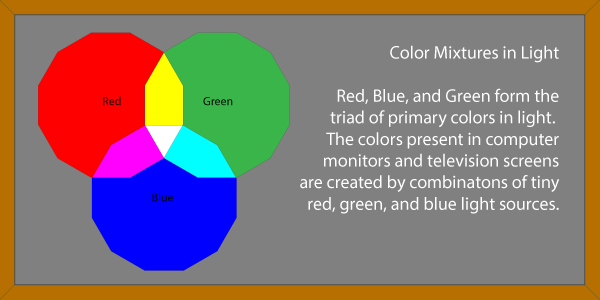
Color that is mixed in light responds differently than in pigment or optical color mixing. The primary colors, those that are the basis for all others and cannot be made from mixed color, are red, green and blue-violet. From these primary colors the secondary colors magenta, turquoise and yellow can be mixed from combinations of two primaries. The result when all three primaries are mixed is white. This occurs because all the colors of the spectrum are present in white light. There is the opposite result when all primaries are mixed in pigments.
Hint
One good example of color mixing in light occurs in video and computer monitors. You may not notice this in your computer because color in computer graphics programs are calibrated to react like pigment.